
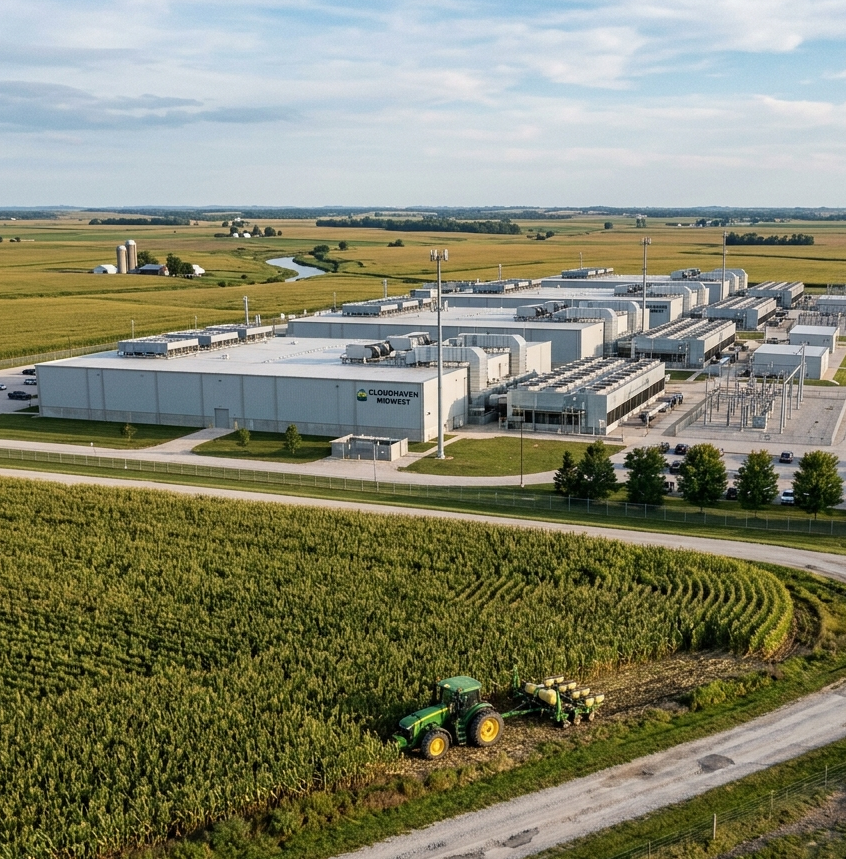
Is a Sun Prairie Data Center in the works?
No one knows the full extent Artificial Intelligence technology will have on our future, but one thing is certain: there is a fierce debate about the pros and cons of data centers’ potential impact on our communities, including Sun Prairie.
As more proposals generate conversations across Wisconsin and Dane County, local officials are clear: no such project is currently planned for the city — but they are preparing for the possibility.
Recent interviews with those involved highlight growing tensions: how to plan for a fast-moving, high-impact industry before it arrives, understanding limitations of current infrastructure, while maintaining transparency and public trust in the process.
A Real World Need for a Virtual Society
While AI chatbots like ChatGPT and Gemini have supercharged demand in recent years, the need for data storage and increased computing power has been growing for decades. Data centers are an inevitable result of increasing time spent online. YouTube, Netflix, Spotify, and TikTok all require more investment in capabilities to support the services used by millions every day.
The pressure from tech companies for further expansion shows no signs of abating, but increasingly, pushback is coming from local residents concerned about how it’s affecting their communities.
No Active Proposal — and Physical Limits for Large Projects
Despite speculation on social media, city officials were unequivocal: there is no current data center proposal under review in Sun Prairie.

“There’s no one who is in active conversation to develop a data center with us right now, and to my knowledge there hasn’t been a serious inquiry in probably three years,” said Planning Director Josh Clements. “We did have an inquiry about three years ago for property in the business park and so at that time, we spent a lot of energy vetting it and learning about it.”
Ultimately, that proposal didn’t move forward because of the power requirements, and Sun Prairie still does not have the transmission lines and infrastructure required to support large-scale development today.
Jeff Christensen is Chair of the Sun Prairie Utilities Commission, where he’s served since 2017, and works closely with Sun Prairie Utilities to monitor the city’s energy capacity. He was clear that the city’s electrical grid simply cannot support a hyperscale facility like those proposed elsewhere in the region.

“We literally could not take a big one on,” Christensen said. “If we tried to plug in something of that magnitude today, it would be like overloading a circuit in your house — everything would go down. That’s not a policy decision, that’s just the physical reality of the system we have in place.”
That reality helps explain why recent major projects have been focused on communities like Beaver Dam and DeForest, which are closer to high-capacity transmission infrastructure.
While a major project isn’t feasible, some companies are looking into smaller-scale facilities, and the nature of technology means circumstances could always change in the future. Taylor Brown, Sun Prairie’s Economic Development Director, has had informal contact about sites in the business park and Bailey Rd, near the Wastewater Treatment Plant, but nothing is actively under review.

Brown confirmed that data centers would be treated no differently than any other development and also clarified the city’s position around confidentiality. “While many projects are confidential in their earliest phases, that confidentiality is not intended to limit public input,” Brown said. “In early stages, there often isn’t enough information to determine whether a project is viable or appropriate for the community.”
She also added that Sun Prairie has never agreed to enter into non-disclosure agreements (NDAs) as part of their process. It’s been requested in the past, but the city declined.
Why the City Is Still Preparing
Even without a current proposal, Sun Prairie has been studying data centers for more than a year — a move officials describe as standard planning, not a signal of intent.
“That experience in 2023 was a wake-up call,” Clements said. “We realized we needed to understand this better — not just what developers want, but what it means for infrastructure, land use, and long-term planning. If something does come forward, we don’t want to be reacting in real time without a framework in place.”
Since then, the city has:
- Created a cross-departmental staff working group that includes public works, Sun Prairie Utilities, sewer, economic development, planning and sustainability.
- Participated in regional workshops and met regularly with groups like Wisconsin Local Government Climate Coalition
- Reviewed how other communities — particularly DeForest — handled proposals
- Begun drafting potential updates to zoning and development ordinances
“What we’re doing now is stress-testing our ordinances,” Clements added. “If a proposal came in tomorrow, how would it move through our system? Where are the gaps? That’s the work we’re focused on.”

The City Council has taken notice as well and asked staff to review the city’s policies. Last fall, Alder Mike Jacobs made a referral asking Staff to study the issue in more detail. Alder Casey Drengler has also proposed a moratorium on any new data center construction in the city. A report outlining potential ordinance changes will eventually go before the Plan Commission and City Council, where elected officials will provide further direction.
Lessons from DeForest and Regional Debate

The city’s proactive approach has been influenced in part by the experience in DeForest, where a proposed $12 billion, 1,600-acre data center campus was ultimately rejected following public backlash.
That process exposed key concerns that are now central to discussions across Wisconsin:
- Energy demand and grid capacity
- Water usage and wastewater management
- Land use at unprecedented scale
- Public transparency and timing of information
Clements said Sun Prairie is closely watching those debates — as well as developments in Beaver Dam, where Meta, the parent company of Facebook and Instagram, is moving forward with a large-scale project. At a cost of $1 Billion dollars, that project is smaller than the DeForest proposal, with 700,000 square feet covering 500-800 acres.
“We’ve been watching DeForest closely,” Clements said. “Not to copy what they did, but to understand the challenges they faced. These projects are complex, and if you don’t have clear policies ahead of time, you’re forced to make very big decisions very quickly.”
Based on recent comments online, it’s clear that some residents will inevitably approach any discussions around data centers with hostility. Clements emphasized that learning from other communities can help provide clear information and honest answers.
Rising Energy Costs are Cause for Concern
As electric bills rise across the nation, many residents are pointing to the expansion of data centers as the culprit. While several factors are contributing to increased energy costs, it’s certainly true that data centers put strain on the electrical grid.
“Some of these facilities use more energy than the rest of the community combined,” Christensen said. “If something like that came here, it wouldn’t be a question of whether we want it — we physically couldn’t support it without major transmission upgrades that take years, if not decades, to plan and build.”
When it comes to a Sun Prairie data center, the issue is straightforward: the system today isn’t built for that level of demand.
Changes in Water Usage
Beyond electricity, water usage is a frequent concern, but Christensen noted that evolving cooling systems have made that less of an issue.
“There’s a perception that these facilities are huge water users,” Christensen said. “In reality, many newer systems use closed-loop cooling, which significantly reduces water consumption. The bigger issue now is wastewater — how it’s treated, how often systems are flushed, and whether your infrastructure can handle that.”
That shift underscores why officials say staying informed — and relying on subject-matter expertise — is critical.
Economic Reality: Significant Upside — With Tradeoffs
Beyond water issues and electrical capacity, data centers present a complicated economic picture.
Trade and Labor Unions have been largely supportive of the jobs they provide. The Meta facility in Beaver Dam is expected to support over 1,000 skilled trade jobs during peak construction and more than 100 permanent jobs for ongoing operation.
Last fall, Kent Miller, President of the Wisconsin Laborers’ District Council posted a video saying, “Data centers create thousands of great-paying, union constructions jobs. They have huge impacts on our members’ lives, how they provide for their families, their health care, their retirement and a good middle-class wage.”
There are also legal limitations on how much the city can dictate what’s built on private property. Private landowners, particularly those with large parcels zoned for industrial use, are eager to encourage this type of development. Land that might otherwise remain vacant, agricultural, or low-value property can become highly attractive at a time when new manufacturing or commercial construction has slowed down.
That increase in property value can dramatically expand a city’s tax base. Compared to new housing developments, data centers don’t add students to the school district, or require more city services like roads, police and fire coverage.
Had the DeForest project been built, financial projections showed the Village would have been able to reduce its mill rate by 25-30% over the next 15 years.
“If the data center that was proposed in DeForest had been built out, it was going to be almost three times the value of the entire village,” Clements said. “That’s a significant benefit for your tax base.”
But he also stressed those benefits only materialize if the project is structured well and remains viable long term, which is why they’re taking the time now to examine city policies and best practices.
Sun Prairie Utilities: Advantages of Being City-owned
Electricity follows a complex path before it ever reaches a light switch—generated at power plants, stepped up to high voltages for efficient long-distance transmission, then routed through substations where it’s stepped back down and distributed across local lines into homes and businesses.
For the city of Sun Prairie, transmission lines are operated by ATC and distributed by WPPI Energy, a member-owned, non-profit entity located in the city’s business park. WPPI provides power to 51 community-owned utilities, including SPU, who provide the “last mile” locally.
Unlike other services, like cell phones or TV, consumers don’t have a choice in where they get their electricity, meaning utilities operate as a monopoly. As a result, the system is governed by several layers of oversight at the federal, state, and local levels to ensure reliability, safety, and fair pricing.
Having a city-owned utility provides several advantages, including local decision-making and cost savings for customers.
“We have a lot more control than a community like DeForest because we have a municipal utility, not an investor-owned utility,” Clements said. “There’s an additional transparency, public decision-making step there. Any power agreement of that size would have to be approved by the SPU board.”
Christensen confirmed that the structure adds an additional layer of public oversight. “Nothing can happen in darkness,” he said.
Christensen also noted the savings that Sun Prairie’s model provides. “MG&E, Alliance, WE Energies – they’re investor-owned, which means they have the responsibility to deliver dividends to their shareholders.” Christensen added, “If you were to cross Hoepker Rd and be in Madison, you would be served by MG&E and pay 20 or 25% more for your electric than you do here because we have removed that investor burden.”
Community Concerns: Transparency and Trust
While officials emphasize their commitment to preparation and transparency, some residents and observers remain skeptical.
Local activist Quinn Natzke, who has built a following covering data center issues statewide, said there are a variety of concerns from people opposing these developments, but she’s primarily concerned with the lack of communication.

“I’m in the group much more concerned about the lack of transparency and the lack of information – to a certain extent that correlates with all of the poorly written or misunderstood legislation that kind of led up to this point.”
In a series of video posts, Natzke has offered to provide “Data Center 101” talks to relay her experience with other projects around the state.
She also criticized broader issues with the process, including:
- Limited opportunities for public votes
- Long-term tax incentives for developers
- Messaging that emphasizes benefits over tradeoffs
After several negative experiences with other communities, Natzke acknowledged that she comes into these situations with a mistrust of local government. “The stuff I’ve seen with government officials and data centers, I don’t trust them because of the pure and simple fact that I have seen them say one thing and then their emails say something completely different.”
Natzke, who lives on the east side of Madison, hasn’t commented on the unique structure of SPU as a city-owned utility, and apologized for making incorrect statements in a recent video.
City Response: A Commitment to Preparation and Sustainability
Despite ongoing concerns from residents, city officials dispute the idea that preparation signals intent to attract a data center.
They say internal discussions, meetings with developers and participation in industry workshops are standard due diligence — not evidence of a pending project. Clements says it’s important to educate himself, city staff and our elected leaders on the realities of these projects. With more information, Sun Prairie can be a leader on issues, rather than getting into a situation that could be unfavorable to residents.
“Being silent on the issue is probably the worst-case scenario,” Clements said. “That’s how you get caught unprepared.”
An ongoing area of emphasis is Sustainability. Despite the departure late last year of the city’s Sustainability and Resilience Manager, Dr. Rose Daily, Sustainability Coordinator Hannah Best is continuing to study how to reduce environmental impacts. A draft of Sun Prairie data center recommendations focus on balancing performance, efficiency, and environmental responsibility, including:
- Heat island reduction: Use high-reflectivity roofing, vegetated roof systems, and rooftop solar arrays to lower temperatures and reduce cooling demand.
- On-site clean energy: Incorporate solar PV, battery storage, and geothermal or ground-loop systems to cut emissions and improve resiliency.
- Waste heat reuse: Design facilities to capture and potentially distribute excess heat for future district energy use.
- Local carbon offsets: Support urban forestry and tree planting initiatives to help offset operational emissions and align with city climate goals.
What Comes Next
In regards to a Sun Prairie data center, the next steps will address process, rather than a specific project.
City staff will present recommendations to elected officials, who will ultimately decide:
- Updates to zoning and development rules
- Whether to impose a temporary moratorium
- How to structure future public engagement
For now, officials emphasize that residents have time — and a voice — in shaping those decisions. Clements stressed that elected Alders will ultimately set the direction for the future. “We’re trying to make sure that our ordinances are up to the challenge. Then the council will be tasked with weighing in on: What do you want those standards to be? What processes does it follow? Because different communities have handled that differently.”
Bottom Line
Sun Prairie is not currently pursuing a data center — and does not have the electrical capacity to support a large one today.
But as development pressure grows across the region, the city is working to ensure that if a proposal does come, it is met with clear rules, informed leadership and a public process — rather than a scramble to react.
Christensen stressed that community pride and local concerns will ultimately govern major decisions. “Most of the people at the table looking at this live here, so we all care about Sun Prairie. We should always be prepared to protect the resources and the sustainability of this city.”
by Andy Schoenherr
Editor, Sun Prairie Rising
Click Here for More Local News from Sun Prairie Rising
Links:
Village of DeForest Data Center Development Info
Sun Prairie Data Center: No Current Proposal, but City is Preparing for the Possibility
Never miss a story from Sun Prairie Rising!
Subscribe to our newsletter and get a summary sent to your email once a week.
