
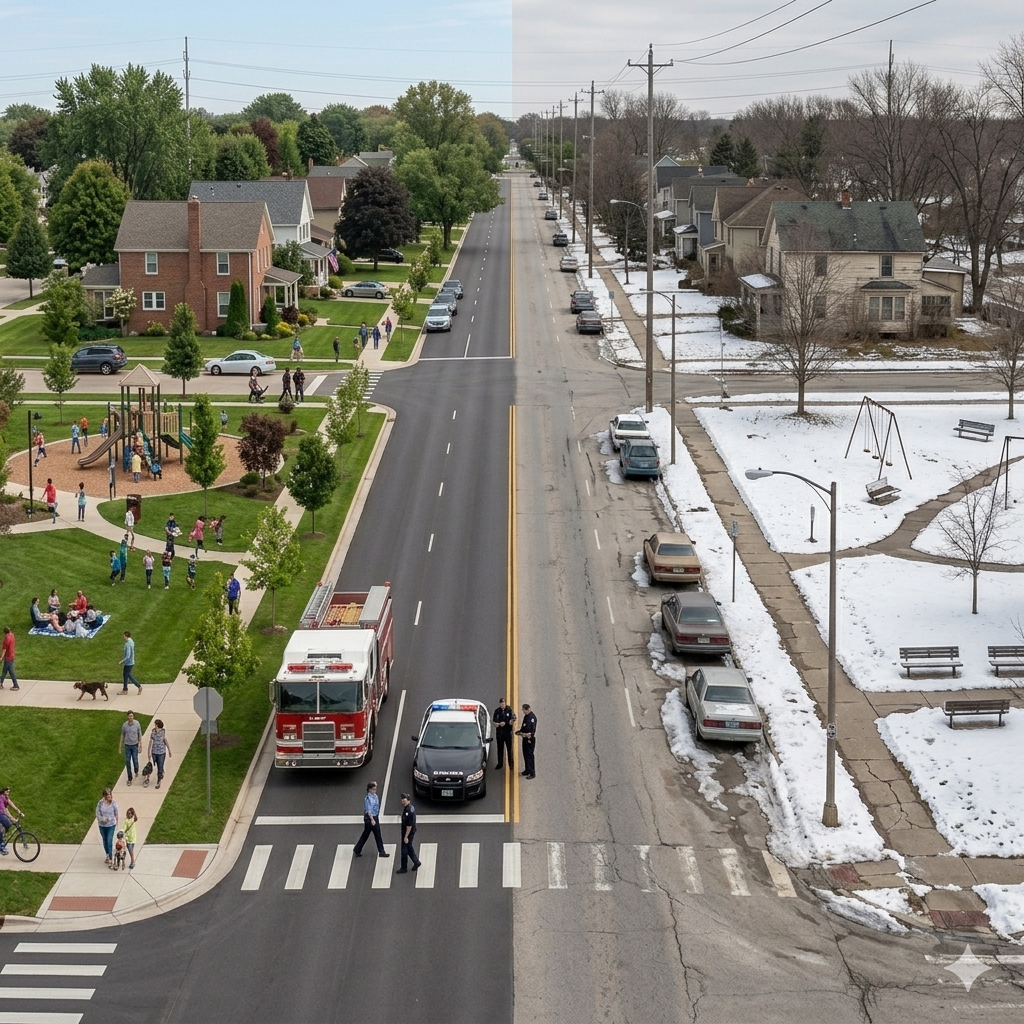
What will change, what hasn’t, and where we go from here….
by Andy Schoenherr
Editor, Sun Prairie Rising
On Tuesday, voters in Sun Prairie voted down a referendum to allow the city to collect an additional $3.95 million in property tax revenue. The ballot question specified the funds were for the “purpose of maintaining current services and increasing staffing in the police and fire departments.”
The 58 to 42 rejection marks a notable shift from just two years ago, when 60% of voters approved a $25 million school district referendum. Similar measures supporting schools have passed consistently over the past decade—in 2016, 2019, 2022, and 2024. Taxes for public schools now make up approximately half of the average homeowner’s property tax bill and will be unaffected by this week’s vote.
So what changed?
Why is there less support when it comes to funding police, fire, EMTs, and other city services compared to paying teachers and building schools? Why were voters willing to absorb a $35–$50 monthly increase for the district, but far less than that for the city?
Maybe it’s just bad timing. Gas prices are skyrocketing, along with tariffs, housing, and food costs, all contributing to a crisis of affordability in the spring of 2026. Apparently, even an incremental increase in taxes was just too much for local citizens to bear.
But while the pressure may feel more acute right now, affordability concerns are nothing new.
They loomed over recent state and national election cycles, when support for Democratic candidates in Sun Prairie exceeded 70%, with turnout over 93%. Anti-tax, small government voices on Facebook, billboards and elsewhere have always been loud. Until yesterday, the electorate in Sun Prairie had always spoken louder.
What hasn’t changed
The city itself hasn’t changed dramatically, either demographically or politically. Our values haven’t shifted. Chris Taylor, a pro-choice, left-leaning judge, carried Sun Prairie by 54 points. In District 2, which generally leans more moderate than the rest of town, Sara Mork, a staunch conservative, was defeated 62% to 38%.
Sun Prairie is still a dark blue city. We’re generally supportive of public investment and shared civic responsibility. So why did we turn a different shade of red when it came to this referendum?
The Real Problem: Confusion, Not Cost
For many voters, cost wasn’t the primary issue. Confusion was.
A lot of the voters I spoke with didn’t fully understand why the additional money was necessary. That points directly to messaging and advocacy. Unlike past school referendums, there was little in the way of coordinated outreach from the usual purveyors of left-leaning political activism — no yard signs, limited social media advocacy, and no clear, unified “Vote Yes” campaign. The only public signage addressing the referendum—two billboards and several banners from Brent Eisberner’s Did You Know SP PAC—was in clear opposition.
When one side is visible and the other isn’t, that matters.
A Harder Message to Sell
There’s also a broader context that made this referendum more complicated than past efforts.
Colleen Hartung, a veteran of numerous progressive initiatives and campaigns in the area, said there may be fatigue—even among typically supportive voters—from repeated asks, whether for schools, the library, Sunshine Place, or other community efforts. She also questioned whether emphasizing police funding was the most effective message.
“People are tired,” Hartung said. “While people basically feel fine about police and fire workers in Sun Prairie, the daily news doesn’t make people anxious to pay more money for increased surveillance. It’s just not a good lead for getting people to vote for increased taxes in this day and age.”
Even in Sun Prairie, where the community has largely avoided high-profile conflicts with police, Flock cameras and overreach are still an issue. The summer of 2020 and the killing of George Floyd cast a long shadow, and more recent national stories about ICE and the killings in Minneapolis haven’t helped rebuild trust in law enforcement among black and brown communities. All of that creates a more complicated environment for a referendum centered on public safety funding.
Education vs Advocacy
Without a grassroots effort in favor of voting YES, the heavy lifting was left to city staff. Asking to fund your own department has an an inherent bias that can undermine credibility, and city employees are limited in what they can say.
Communications Manager Ashley Manthei noted, “As City staff, we cannot advocate for or against the referendum—meaning we can’t encourage residents to ‘vote yes.’ What we can do is educate residents on what a ‘yes’ or ‘no’ vote means as it pertains to the referendum.”
Over the past several months, city staff invested significant time and effort into education—videos, postcards, town halls, and social media outreach. A referendum steering committee, led by Manthei and City Administrator Chief of Staff Sandy Xiong, compiled a communications plan with more than 100 action items leading up to the election.
Ultimately, all those efforts failed to move the needle for voters.
Scare Tactics or not Scary Enough?
Some criticized the city’s approach as relying on “scare tactics.” But is it scare tactics to be honest and upfront with residents about financial realities? That’s how budgets work. The case for what happens without additional funding was never fully or consistently made.
At times, the messaging felt contradictory. Fire Chief Garrison and Police Chief Warych were outspoken that the money was needed for extra staffing, while also remaining adamant that the city would remain safe and services would continue. It’s not hard to see why voters would decline to pay more taxes if things are going to be fine.
But a growing city that can’t add police or fire personnel isn’t holding steady—it’s absorbing more strain, more burnout, and more risk. Tying the Chiefs’ hands on hiring and compensation certainly won’t make it easier to recruit and retain high quality people.
We never really confronted what those changes could mean.
The Uncertain Future
I don’t think Sun Prairie has changed. We want to see growth and new housing and new people, and we want them to share in what we love about our city. We still care deeply about public safety and strongly support the broader ecosystem of city services—libraries, parks, recreation programs, snow removal, and community spaces—that quietly define our quality of life.
But Tuesday’s results reflect a fundamental disconnect between what residents value and what they feel like they’re getting for their investment.
In the weeks leading up to the vote, I talked with current and former elected officials and city employees. I spoke to many on Tuesday night as results came in. There were plenty of theories as to why the referendum failed—but no single, definitive answer.
The path forward is just as uncertain.
Some will push to revisit the question this fall, when turnout will be higher for congressional and gubernatorial races. Others will argue the city should accept the outcome and adjust accordingly, even if it means inflicting some pain from reductions in services. That’s how elections work.
What will be cut?
The 2026 budget is set, but 2027 will look very different, and some reverberations have already been felt.
Without new revenue, the city will be forced to cut positions, and city employees will lose their jobs. Financial uncertainty will limit hiring and accelerate departures. Several key employees have already left voluntarily amid a restructuring designed to make the referendum number more palatable.
While police and fire services will remain top priorities, the deeper cuts will come elsewhere.
They will fall on the services people tend to take for granted—the “extras” that aren’t really extras at all. Educational and after school programs at the Media Center, Library, and Parks, Recreation & Forestry. Public spaces that build community. Core services like snow removal and responsiveness to residents and businesses. The Historical Museum, which preserved the city’s past and served as an anchor for downtown tree lightings and Groundhog Day, is likely to be shut down.
These are the things that make people love living in Sun Prairie—and they are often the first to go.
A Slippery Slope
For years, the city has benefited from a virtuous cycle: strong services attract residents, businesses, and talented municipal employees, which in turn support a growing tax base. That growth helps sustain those same services.
When that cycle breaks, things go south. And they can go south fast.
Services erode. Frustration grows. People disengage—or leave. Businesses follow. Growth slows. Home values stagnate. The things that once felt stable start to slip. Once that slide begins, it’s much harder to reverse than it is to prevent. Suddenly the same voters who rejected a modest tax increase start asking why things don’t feel the way they used to.
The Question Ahead
So the question facing Sun Prairie isn’t just what happens next—it’s whether the community and city leaders are willing to confront what Tuesday’s vote actually revealed.
Because this wasn’t simply a rejection of a tax increase. It was a signal—a gap between what we say we want and what we’re willing to spend to sustain it.
Filling that gap is the new challenge for our leaders at City Hall, both elected and otherwise: Mayor Steve Stocker, the newly seated City Council, and City Administrator Aaron Oppenheimer.
How do you continue to provide services to a city that’s said it doesn’t want to pay for them?

Never miss a story from Sun Prairie Rising!
Subscribe to our newsletter and get a summary sent to your email once a week.